Such questions have been brought up to mind in recent days, as the question of ethnic diversity in Rome. A bitter debate happened between Mary Beard, a classicist at Cambridge and Nassim Nicholas Taleb, a statistician and author. Nassim was the author of a BBC cartoon which implied a Britain in the Roman period that was a little ethnically not the same from the Britain modern times. The presence of a supposedly sub-saharan black man (and his dark children) was apparently enough cause in the controversy-
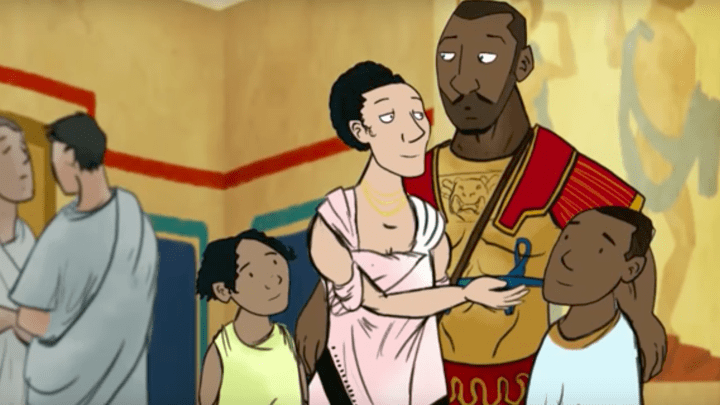
Questions for Taleb seem to have been growing due to the cartoon and how it was representative of a typical Romano-British family, weather this has been misleading for modern audiences. The black man in the illustration is based on a historical figure of Quintus Lollius Urbicus, a roman governor of Britain during the reign of Pius, whose origins were in modern Algeria. Urbicus was well traveled and would’ve been familiar with the wide range or imperial provinces from Britannia to Africa to Judea. Whether he was black or not, for the romans it was clearly immaterial.
The debate itself rests on the word ‘diversity’. Its modern implications are mostly associated with the multicultural policies of modern Western states and those who are certainly foreign to the ancient Roman Empire. If those who recommend for a diverse Roman Britain can be criticized for anything, it is not strict enough distinction between ancient and modern political and cultural circumstances. Clearly the word ‘diversity’ needs to be deployed in a way when talking about ancient societies. Rome should not be demented for a modern post-Enlightenment state. In society and culture, we disregard the buying and selling of human beings of chattel, and no social context, which I can argue make right and good. On the other hand, the Roman state was great in many respects, to embrace the wide variety of ethnicity, tribal, and national identities. As we know Urbicus was an example of this.
No one worthy of rule or trust remains an alien, but a civil community of the World has been established as a Free Republic under one, the best, ruler and teacher or order; and all come together as into a common civic centre, in order to receive each man his due. –‘Roman Oration’, part 60. Trans Oliver.
I believe if Romans were really worried with the ethnic backgrounds, they wouldn’t have had most of the resources that they did back then. Having different types of ethnicity was good for the romans. A good example would be the roman army, showing that having diversity can give you an advantage because you can choose the strong ones and go to another city and choose other strong men despite their ethnicity.
https://www.theatlantic.com/science/archive/2017/08/dna-romans/535701/
http://blogs.reading.ac.uk/the-forum/2017/07/28/how-diverse-was-roman-britain/
 An Infinite Journey